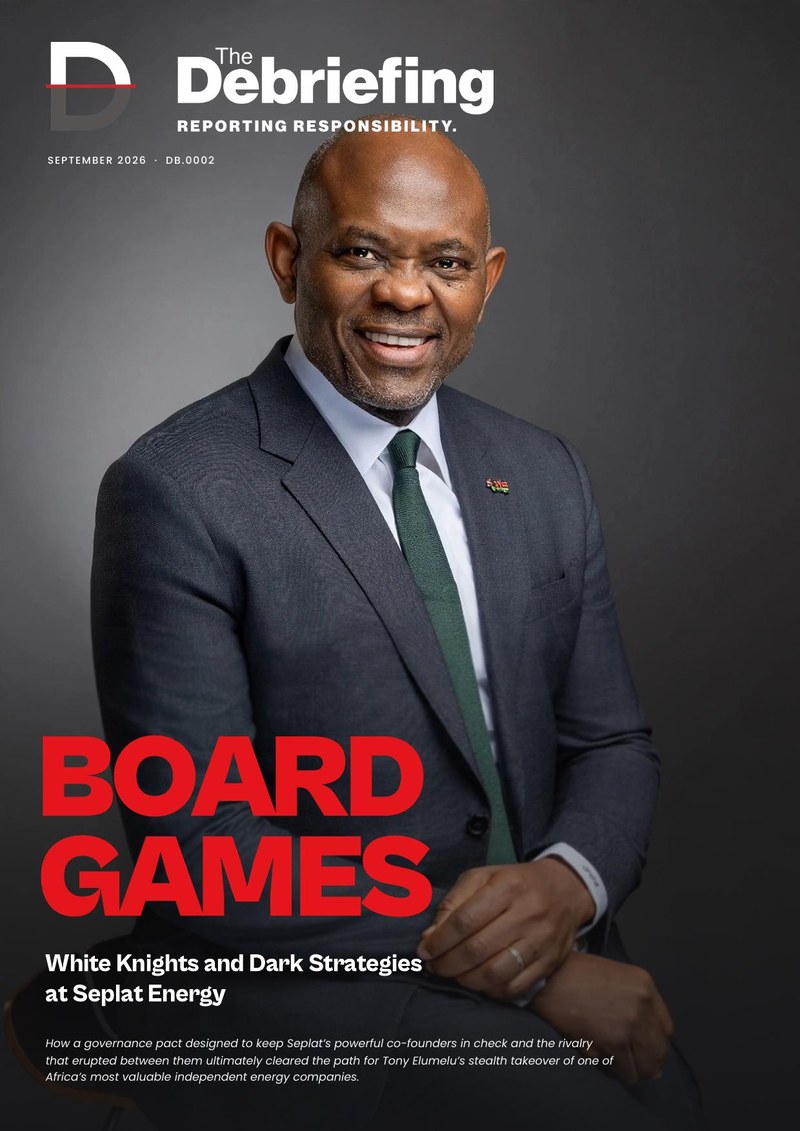
White Knights and Dark Strategies at Seplat Energy
How a governance pact designed to keep Seplat’s powerful co-founders in check — and the rivalry that erupted between them — ultimately cleared the path for Tony Elumelu’s stealth takeover of one of Africa’s most valuable independent energy companies.
By Obiora Tabansi Onyeaso·52 pages·September 2026
Summary
The Debriefing unpacks the boardroom power tussles and stealth takeover of Seplat Energy
The Debriefing has published Board Games: White Knights and Dark Strategies at Seplat Energy, a long-form study by Obiora Tabansi Onyeaso of how Nigeria’s largest independent oil company was built, how control of it changed hands, and what Tony Elumelu’s elevation to its chairmanship, which takes effect in January, may mean for what it becomes next.
The piece follows Seplat from its founding by ABC Orjiako, a prize-winning surgeon turned dealmaker, and Austin Avuru, one of Nigeria’s finest petroleum geologists, to its dual listing in London and Lagos and its present position as the country’s leading indigenous producer.
It gives particular attention to the company’s founding partner, Maurel & Prom, and its founder Jean-François Hénin, whose early capital and credibility won Seplat its first blocks, whose stake was the deciding vote in the boardroom for fifteen years, and whose sale of that stake in December 2025 brought Elumelu in.
Seplat’s story is told against the largest change in Nigerian oil in a generation. Between 2010 and 2025 the international majors moved their capital from the onshore Niger Delta to deepwater, and Nigerian companies took over the fields they left, paying more than fifteen billion dollars for them.
Seplat’s 2010 purchase from Shell was the first of these transactions and the model for those that followed, among them Wale Tinubu’s acquisition of ConocoPhillips’ Nigerian business for Oando and Benedict Peters’ purchase of OML 29 for Aiteo. The issue maps the full sequence and considers what it has meant for the delta, for Abuja and for the operators who now carry the assets.
It is also a study of a question every successful founder-led company in Africa eventually faces: what happens after the founders. Seplat’s two founders built a national champion and, over the following decade, came to disagree about its direction and their places in it.
The piece examines how the company came through that period intact: through the discipline of a London listing, through a contested succession decided in a Dubai boardroom in 2019, and through a board that kept to its own rules until a shareholder arrived with the votes to change them.
Those rules are the third thread. Seplat’s governance was designed to restrain the power wielded by any single large shareholder. Drawing on the experience of Oando, Pan Ocean Oil Corporation, Nestoil and Chappal, the piece also explores commercial disputes among large shareholders of systemically important companies in the industry that escalated through direct confrontation and the use of proxies to involve regulators, the courts, the police and anti-corruption agencies, often simultaneously, before scaling back.
Board Games closes on what comes next. Seplat’s own five-year plan commits it to 200,000 barrels of oil equivalent a day by 2030, half as much again as it produces today, with Effiong Okon, the engineer who brought the ANOH gas plant to first gas in January, now chief executive. Beside that sits the question of OML 17, the block Elumelu’s Heirs Energies already holds, and whether it will one day be combined with Seplat. His record at UBA and Transcorp, set out in the issue in figures, suggests what a patient investor does with a controlling stake.
The author drew from sources in the public domain: Seplat’s prospectus, stock exchange announcements, audited results and capital markets day disclosures, Maurel & Prom’s regulatory filings, court records, books, and the reporting of respected media titles. Board Games is richly illustrated with photographs, charts, a two-page map of the majors’ divestments since 2010 and a timeline of the company’s ownership.
The edition is available for download on this page.
The author, Obiora Tabansi Onyeaso, is the founder and managing director of Podhium, a Lagos-based reputation ratings institution that builds evaluation infrastructure and reputation intelligence for structurally opaque markets. He can be reached at obiora.onyeaso@podhium.com.
About the author
Obiora Tabansi Onyeaso
Founder and Managing Director of Podhium, a Lagos-based reputation ratings institution that builds evaluation infrastructure and reputation intelligence for structurally opaque markets. Over two decades at the intersection where corporate governance, market reputation and capital allocation meet in Africa.
The Debriefing is the authoritative source for business, policy and enterprise journalism in Nigeria and across Africa. Independent, journalist-led, and free from commercial influence, it delivers rigorous reporting, data-driven analysis and actionable insights on the private sector, regulation, entrepreneurship, financial services and the macroeconomy.
The full 52-page story (PDF, 11MB). Complimentary, on registration.
The email address provided will be used solely to confirm this download. It will not be added to any mailing list, shared with third parties, or used for any other purpose.
Please complete all required fields.
✓
The story has opened in a new tab. If your browser blocked it, open it here.