IL · IVORY LEAGUEThe Ranked 50 Nigerian Private Universities · 2026 Edition · by Podhium
IVORY LEAGUEOverviewThe Ranked 50MethodologyEditorial StandardsRecognition
Methodology · 2026 Edition

The Ivory League

Scoring architecture · Pillar weights · Stated limits
01 — How the score is built
Eleven pillars. External evidence only. No self-reporting.


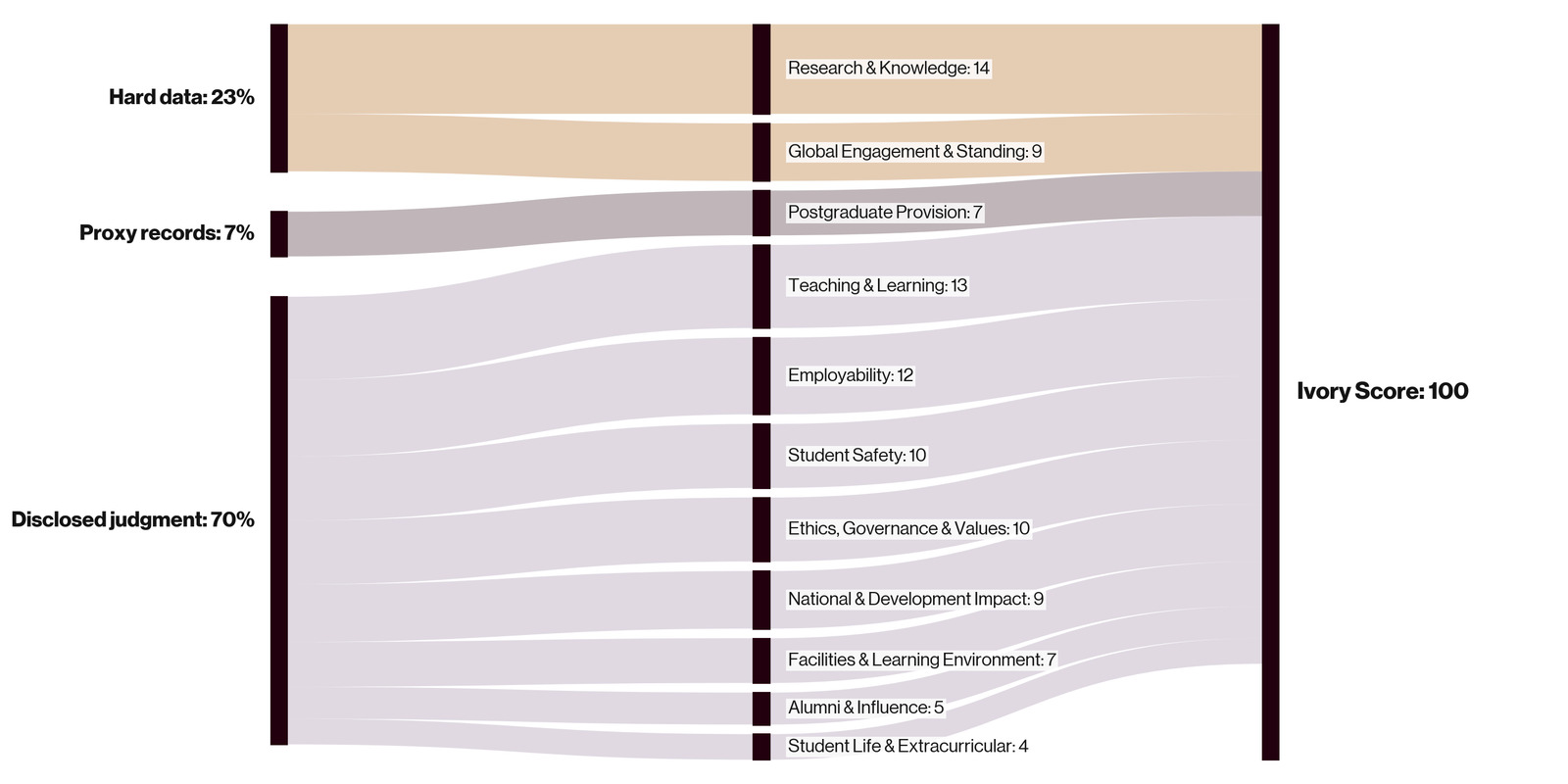
The Ivory Score (0–10) is a weighted composite of eleven pillars across four families. Research and standing are carried by public, verifiable data. The remaining dimensions are set by calibrated judgement anchored to verifiable signals: accreditation, professional-school provision, teaching-hospital affiliation and the national games. Every input is external. No institution supplies its own data.

# Pillar Weight Basis Family
01Research & Knowledge14%DataScholarship
02Teaching & Learning13%JudgmentScholarship
03Employability12%JudgmentEmployability
04National & Development Impact9%JudgmentCharacter
05Global Engagement & Standing9%DataScholarship
06Student Safety10%JudgmentWellbeing
07Ethics, Governance & Values10%JudgmentCharacter
08Facilities & Learning Environment7%JudgmentWellbeing
09Postgraduate Provision7%ProxyScholarship
10Alumni & Influence5%JudgmentCharacter
11Student Life & Extracurricular4%JudgmentWellbeing
Score Distribution
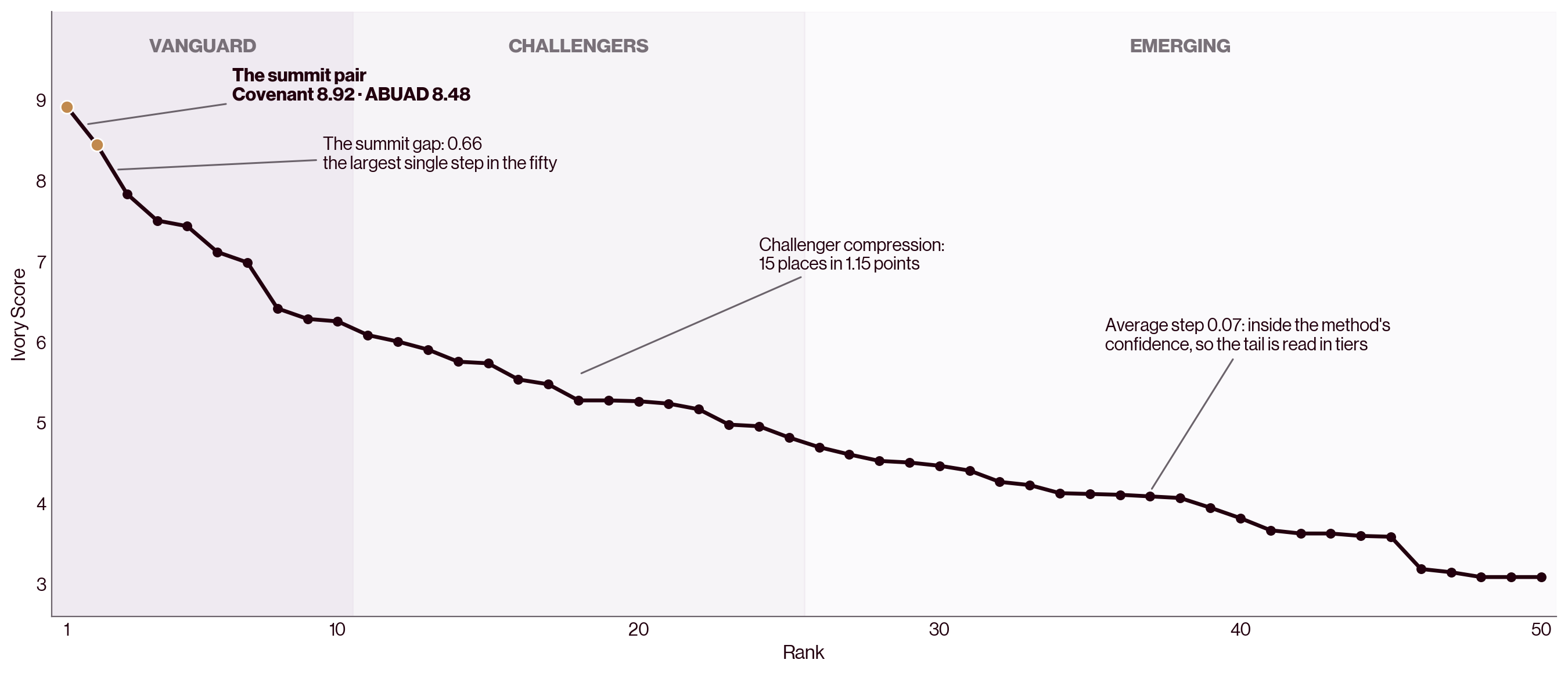
Ivory League 2026 score distribution
Pillar Contribution Flow
Ivory League 2026 pillar contribution Sankey diagram

Confidence flags. Every institution carries a confidence flag: High through the leading group (where evidence is deep and verifiable); Medium in the middle range; Indicative in the tail, where the tier matters more than the exact position. The trajectory flag sits entirely outside the composite — it is never used to reorder the table.

Download the full report
02 — Transparency

The score can be recomputed. That is the point.


Because the weights are published in full and every input is traceable, any reader can recompute the Ivory Score for any institution from the public documentation. There is nowhere for a quiet adjustment to hide.

Right of reply is free and open to every institution, ranked or not. A factual error in the data used is corrected, re-scored through the published method, and logged in the public corrections log with date, institution, what changed and the source. View the corrections log →

03 — Right of Reply

Every institution may be heard.


Any university — ranked or unranked — may challenge the data used in its assessment at no cost. Where a factual error is confirmed, it is corrected, re-scored, and logged publicly. Where a challenge concerns a judgement, we respond with the methodology and the evidence base. The same process applies to every institution, regardless of any commercial relationship.

Request your evidence base

Submit corrections or initiate the right of reply before the next cycle closes.

Begin right of reply →